


Saturday 14th November 2026, time 16:00 Duration: approximately 60 minutes.
Registration is required and opens three weeks before the event: zapisy@centrumdialogu.com Places are limited.
Between Arab Identity and the West: A Few Words About Palestinian Music | Event
What?
What happens to musical traditions when they encounter the global world of pop culture? Does embracing rock, hip-hop, or electronic music mean adopting Western influences, or can these genres instead become a way of expressing one’s own identity?
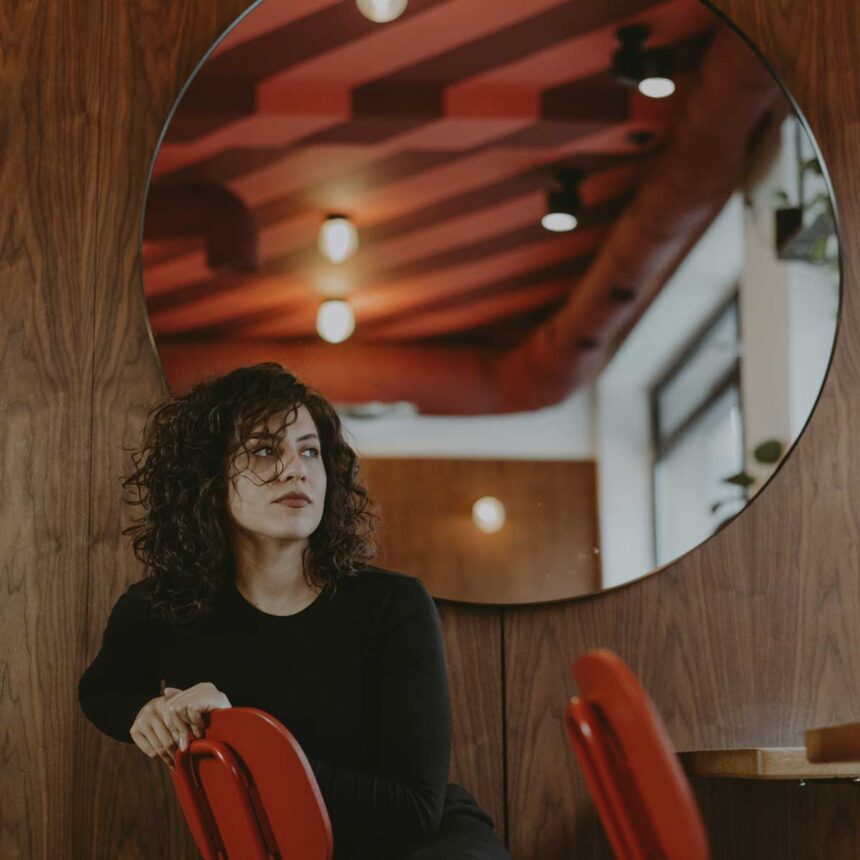
In her lecture, Aya Al Azab will explore contemporary Palestinian music as a space where different traditions and artistic languages come together. She will focus on the tension between a strong connection to Arab cultural heritage and the influence of colonialism and globalisation. In the Palestinian context, the question of cultural distinctiveness also has a political dimension, becoming one way of sustaining a sense of identity under occupation.
Palestinian musicians have been drawing on Western popular music since the 1960s, while contemporary artists work with genres such as electronic music, rock, and hip-hop, combining them with Arabic vocals, language, and traditional instruments. Some turn to these genres as a language of resistance, while others use them to assert their own cultural identity even more strongly.
The lecture will offer an introduction to this musical world and explore the different ways in which Arab traditions are combined with contemporary styles. One of the key examples will be the work of the Palestinian ensemble Le Trio Joubran.
Who?
Aya Al Azab – a music critic and musicologist of Polish-Jordanian heritage, combining academic research with journalism. She contributes to JazzPRESS and Jazz Forum and has also written for Ruch Muzyczny and Pismo Folkowe. She hosts her own programmes on Polish Radio Lublin and is a member of the popular music studies research group at the Jagiellonian University’s Institute of Audiovisual Arts. Since 2024, she has co-created the “Krzysztofory – Kraków Culture Studio” project at the Museum of Kraków.
For Whom?
For anyone interested in music, Arab culture, and Palestine, as well as those who want to better understand how music evolves through migration, globalisation, and encounters between different traditions.
No previous knowledge of the history of Arab music or the contemporary Palestinian music scene is required. The lecture is designed as an introduction and can also be a great way to prepare for experiencing the music of Le Trio Joubran.
Why is it worth it?
Palestinian music offers a way of understanding multiculturalism not as the coexistence of separate, unchanging traditions, but as an ongoing process of exchange, borrowing, and transformation. Hip-hop, rock, and electronic music do not simply stop being “Western” when they appear in Palestine – but Palestinian artists are not passive recipients of these forms either. They make them their own, transform them, and use them to tell stories rooted in their own experiences.
Particularly interesting is the tension between the global circulation of contemporary music and the desire to preserve a distinct cultural identity. In the Palestinian context, this is more than an aesthetic question. Language, traditional instruments, and references to local heritage can also become ways of asserting the presence and continuity of a community.
This perspective is close to the Łódź of Many Cultures Festival’s understanding of culture as something that is neither fixed nor simply inherited once and for all. Culture is created through relationships – including difficult ones shaped by inequality, colonial histories, and political conflict.
So rather than asking whether contemporary Palestinian music is sufficiently “traditional” or “Western”, it is more interesting to listen to how artists draw on both to create a language of their own.
The lecture may also change the way we listen to Le Trio Joubran, allowing us to hear not only the distinctive sound of the oud, but also a broader story of tradition, modernity, and cultural identity.
Availability
The event will take place in the meeting room on the first floor of the Marek Edelman Dialogue Center in Łódź.
The Dialogue Center building is accessible to people with mobility impairments. It has wide, non-automatic entrance doors, an accessible restroom, and an elevator. The theater is located on the ground floor, has a ramp, and the auditorium includes spaces for people in wheelchairs. In front of the building, there is a large parking lot with designated spaces for people with disabilities. Assistance dogs and guide dogs are welcome both inside the building and in the auditorium. The building is equipped with the ToTuPoint audio navigation system. The entrance to the parking lot is on Wojska Polskiego Street. Nearby bus and tram stops include: Wojska Polskiego/Centrum Dialogu and Wojska Polskiego/Sporna.
Photos
Aya Al Azab, photo Kinga Krupa, press mat.