

A User’s manual for normality | exhibition
What?
Tomasz Grabowski’s exhibition, “A User’s Manual for Normality,” offers a critical reflection on societal definitions of the norm, using humor, irony, and subversive shifts in perspective to reveal the mechanisms of exclusion present in everyday language and visual culture.
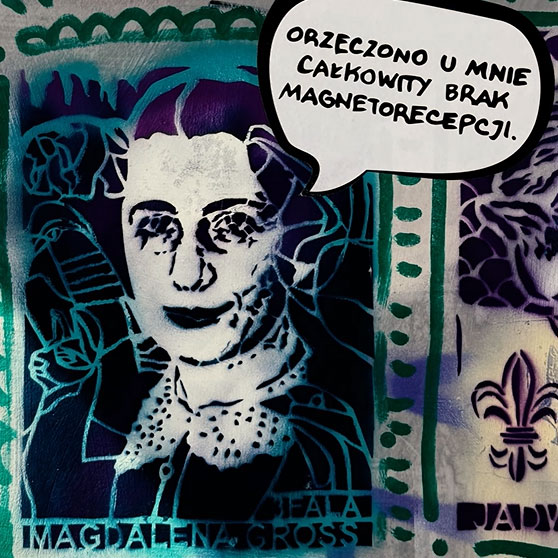
The exhibition consists of posters, portraits, and performance-video works. The starting point is the concept of alternative ways of perceiving the world—such as echolocation, magnetoreception, and bioluminescence—which challenge the belief in the existence of a single, universal model of ability. The artist deliberately draws on the language of social posters, the aesthetics of the Polish poster school, and interventions in urban space, creating works that straddle the line between art, social provocation, and the visual essay.
One of the exhibition’s central themes is the presence of the Deaf community and a critique of stereotypes regarding communication and disability. Portraits of prominent Deaf figures restore visibility to those who contribute to culture, science, and social life, while simultaneously challenging the paternalistic narratives entrenched in mainstream culture.
Who?
Tomasz Grabowski—graphic designer and visual artist, a graduate of the Faculty of Graphic Arts at the Academy of Fine Arts in Warsaw and a scholarship recipient at the École supérieure Estienne des arts et industries graphiques in Paris. Recipient of a scholarship from the Minister of Culture and National Heritage (2026). In his work, he employs the language of the poster, urban intervention, and performance art to explore the social mechanisms of exclusion and representation.
Dr. Agnieszka Kołodziejczak—curator of the exhibition “Instructions for Normalcy,” art historian, graduate of the Academy of Fine Arts in Łódź and the University of Łódź, Ph.D. in the humanities, research assistant in the Department of the History of Painting and Sculpture at the University of Łódź. Project specialist at the FIDEES Social Ideas Foundation and vice president of the Ucieleśnienie Foundation.
For Whom?
The exhibition is aimed at anyone interested in contemporary art, graphic design, visual culture, and the social mechanisms of exclusion. It is intended both for those involved in the art world and for anyone who wishes to take a critical look at seemingly obvious concepts such as “normality,” “ability,” and “otherness.”
Why is it worth it?
The Łódź of Many Cultures Festival encourages viewers to look at the world from different perspectives and to question entrenched ways of thinking about identity, community, and diversity. “A User’s Guide to Normality” expands on this idea by drawing attention to the mechanisms of exclusion embedded in everyday language, imagery, and social norms. The exhibition does not offer simple answers or ready-made definitions. Instead, it invites reflection on who sets the boundaries of “normality” and what consequences these boundaries have for people who exist outside the dominant norms. Humor and irony become tools for critical thinking, and art becomes a space for dialogue about diversity and visibility.
Availability
The opening will be interpreted from Polish Sign Language into spoken language and from spoken language into Polish Sign Language (PJM), making the event accessible to both Deaf and hearing people.
The Dialogue Center building is accessible to people with mobility impairments. It has wide, non-automatic entrance doors, an accessible restroom, and an elevator. The theater is located on the ground floor, has a ramp, and the auditorium includes spaces for people in wheelchairs. In front of the building, there is a large parking lot with designated spaces for people with disabilities. Assistance dogs and guide dogs are welcome both inside the building and in the auditorium. The building is equipped with the ToTuPoint audio navigation system. The entrance to the parking lot is on Wojska Polskiego Street. Nearby bus and tram stops include: Wojska Polskiego/Centrum Dialogu and Wojska Polskiego/Sporna.
Photos: Tomasz Grabowski, Agnieszka Kołodziejczak, press materials.