
Saturday, November 7, 2026 Time: 12:00
Registration is required (opens 3 weeks before the event) zapisy@centrumdialogu.com The meeting and the open discussion in a circle are the two parts of the event. Separate registration is required for each part – when registering, please indicate whether you wish to participate in one part or both. Number of spots: 30. Spots are assigned on a first-come, first-served basis. If there are still spots available after the first part, you will be able to join the discussion in a circle.
The meeting will be conducted in English, with interpretation into Polish and Polish Sign Language.
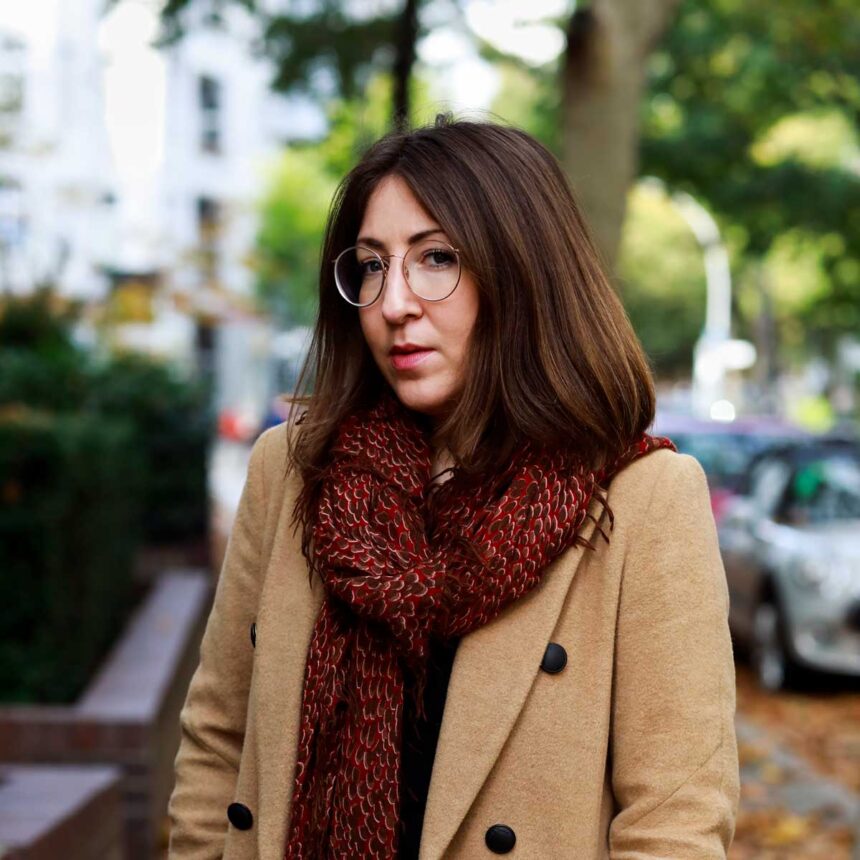
Beyond orthodoxy | meeting with Deborah Feldman
What?
autobiographical book “Unorthodox: How I Left the World of Orthodox Jews”, which made the “New York Times” bestseller list, has been translated into 30 languages, and has been adapted into an Emmy-winning Netflix series.
Feldman grew up in a closed, ultra – Orthodox community of Satmar Hasidim in New York. Her native language is Yiddish, and her grandparents, who raised her, were Holocaust survivors from Hungary. Growing up in Williamsburg, Feldman secretly studied literature, and at the age of twenty, she left the community where she had spent her entire life up to that point. She later moved to Berlin with her son.
During the “Beyond Orthodoxy” event, Deborah Feldman will discuss the experiences that served as the basis for her books and also inspired her subsequent public activism. The conversation will be an opportunity to go beyond the story told in “Unorthodox” and explore questions of identity, religion, emancipation, and the price one sometimes must pay for the right to make one’s own decisions about one’s life.
Monika Bobako will lead the discussion with the author. After a short break, we invite you to join an open conversation in a circle. You’ll have the opportunity to share your thoughts and feelings inspired by the book and the preceding discussion, but it will be equally important to listen to the experiences and perspectives of others. Facilitators from the New Community Foundation will ensure that the meeting proceeds smoothly and that the atmosphere is one of solidarity and appreciation for diversity.
Who?
Deborah Feldman — a German-American writer born in 1986 in New York City. She was raised by her grandparents, Hungarian Jewish Holocaust survivors, in the Orthodox Hasidic Satmar community in Williamsburg. Her native language is Yiddish. She secretly studied literature, then left the community and moved to Berlin with her son. Her autobiographical book “Unorthodox” has sold over a million copies, been translated into 30 languages, and the international TV adaptation based on it won an Emmy Award. Today, Feldman is a prominent voice in the German public debate.
Monika Bobako – a philosopher and scholar specializing in postcolonial and feminist issues – will lead a discussion with Deborah Feldman.
The New Community Foundation (Fundacja Nowej Wspólnoty) – an organization that has been active since 2020, working to bridge divides and strengthen community in Poland. It brings together people from different generations, backgrounds, and worldviews through its activities, which include Community Dialogues, Good Conversation Workshops, and Local Conversation Courses.
For Whom?
This event is aimed at both readers of Deborah Feldman’s books and those who discovered her story through the TV series “Unorthodox,” as well as anyone interested in contemporary Jewish culture, religion, feminism, emancipation, and the experience of living between different worlds. It is also an opportunity for those interested in the question of whether it is possible to construct one’s own identity –especially when that means challenging the norms of the community in which one grew up. No prior familiarity with Feldman’s work is necessary – this event may serve as your first encounter with her biography and writing.
Why is it worth it?
Deborah Feldman’s story fits particularly well with the spirit of the Łódź Multicultural Festival because it challenges the very notion of cultural belonging. It shows that culture is not merely a heritage that we receive and preserve, but also a space for negotiation, tension, and individual choices. We can be rooted in the language, memory, and history of our own community, while at the same time questioning its prevailing norms and seeking a different way of life for ourselves.
Feldman’s biography takes us from the Yiddish-speaking Hasidic world of Williamsburg, through her experience of leaving the community, all the way to contemporary Berlin, where the writer has become an important Jewish public voice. Her story thus allows us to view multiculturalism not as a simple mosaic of distinct and unchanging cultures, but as a reality shaped by people moving between languages, places, traditions, and ways of thinking about themselves.
“Beyond Orthodoxy” will be a conversation about the right to choose one’s own path, but also about what we take with us when we leave the world that shaped us. It is a question of freedom and emancipation, but also of memory, heritage, and the possibility of building a relationship with one’s own culture on new terms.
Partner
The Foundation for Polish-German Cooperation
Availability
The meeting will be interpreted into Polish Sign Language (PJM).
The Dialogue Center building is accessible to people with mobility impairments. It has wide, non-automatic entrance doors, an accessible restroom, and an elevator. In front of the building, there is a large parking lot with designated spaces for people with disabilities. Assistance dogs and guide dogs are welcome both inside the building and in the auditorium. The building is equipped with the ToTuPoint audio navigation system. The entrance to the parking lot is on Wojska Polskiego Street. Nearby bus and tram stops include: Wojska Polskiego/Centrum Dialogu and Wojska Polskiego/Sporna.
Partners:
The Foundation for Polish-German Cooperation and Poradnia K Publishing House